Abstract
Tracking progress for the final project - the theremin!
Progress tracking
- See week 1 for some initial ideation about the project.
- As I learned about microcontrollers in week 2, it seemed to me that they might be an easier route towards making a theremin - ie., a digital rather than an analogue version may be easier to implement, due to less strict requirements on geometric modelling concerning capacitance and inductance of the circuitry invovled.
- It seems like having the two antennae act, in some sense, as input devices, like the bare metallic buttons on the QPAD, may be the way to go. Of course, I expect their behavior to be different due to the size and geometry differences, but conceptually, it should be something similar. I am waiting for the input devices week to get a clearer picture.
- The sound should be created by some sort of speaker connected to the microcontroller. A naive idea would be to create single pitched sounds with the pitch given by the corresponding antenna. However, to emulate a more realistic musical instrument, I expect to have to do a lot of sound engineering in adjusting the presence of overtones, timbre, etc. I have no musical training, and only know about these notions from my training in physics. I am waiting for the output devices week to develop a clearer concept about how to emit the sounds and how to map the input to the output.
- See week 5 for a preliminary design of a circuit board based on an RP2040 microcontroller for the theremin.
- See week 6 for a milled circuit board using an MP3 player to play music on a speaker, as well as with pins to connect to outside input devices.
- See week 7 for a first version of the theremin shell.
- See week 8 for a version of the step response with discharge through an external resistor through a common ground, as well as some preliminary attempts at using a remote processor for the step response.
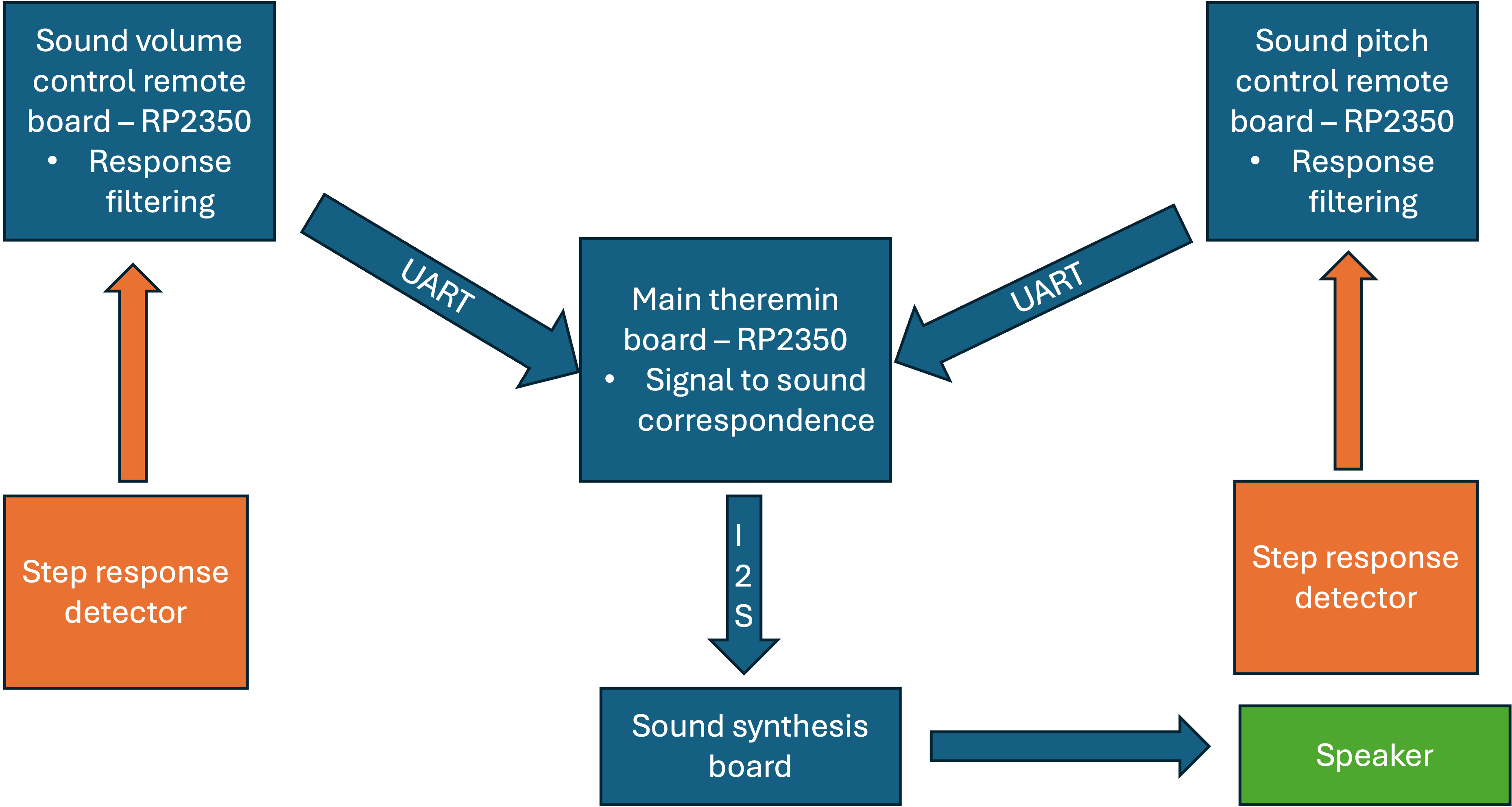
- See week 9 for a (barely) working version of the step response detector with a remote processor, as well as some reflections on its limitations and a discussion of alternatives. Also, a working first version of the sound synthesis with the I2S module based on the step response input.
List of tasks still to be done, and scheduling
- Sanding and sealing theremin case - week of Nov 23
- Figuring out aesthetic and functional details: fixturing for wires, step response plates, enclosure for speaker, etc - week of Dec 1
- Experiment with RP2350 as remote processors for the two theremin plates, as well as communication between several RP2350 over UART - week of Dec 1
- Finalize PCB design and electrical details; figure out effective grounding scheme in particular; decide on detector geometry and discharge resistor - week of Dec 7
- Tune software filtering and sound synthesis - weekend prior to final project presentation
System diagram